

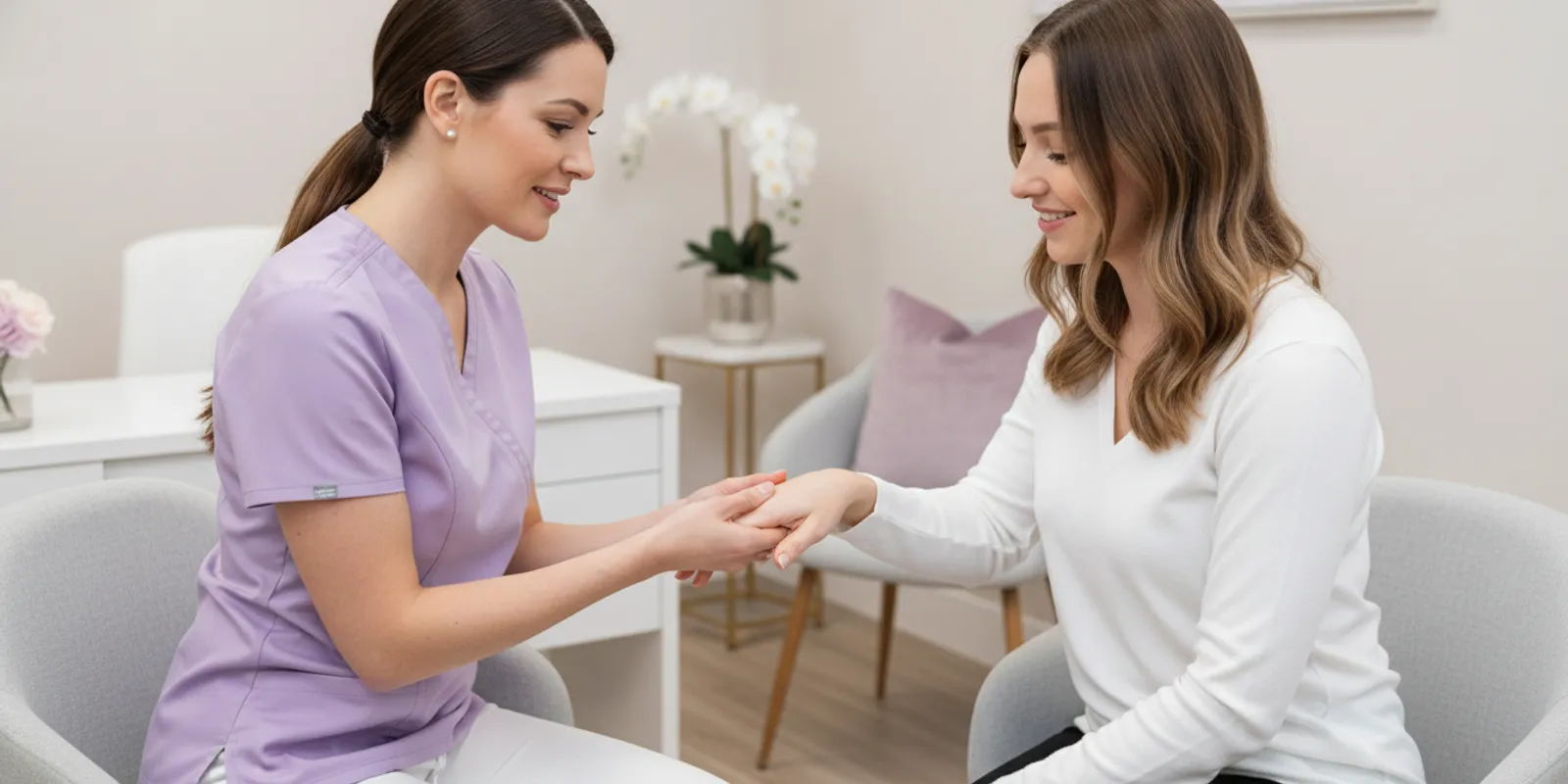
Skin turgor is the skin’s ability to change shape when gently pinched and then return toward its usual appearance. For a practice evaluating assessment tools, the key question is not whether the term sounds useful, but what it can reliably tell a clinician—and what it cannot. Skin turgor is a physical finding, not a complete hydration assessment or a reason by itself to buy a device.
Talk with Emage Medical about skin-imaging options
What does skin turgor describe?
Skin turgor describes the skin’s elasticity and its return after a small fold is lifted or pinched. In everyday clinical language, a clinician may describe the skin as returning promptly or as having a delayed return. The observation is one piece of a broader assessment. It does not directly measure the amount of fluid in the body, and it does not identify the cause of a change.
The finding is sometimes discussed in relation to dehydration. That association can make it sound like a quick, dependable hydration test. It is more accurate to treat skin turgor as one observation whose meaning depends on the person, the examination, and the clinical context. The National Library of Medicine’s MedlinePlus overview of skin turgor defines it as the skin’s elasticity and ability to return to normal after changing shape.
For an aesthetic practice, this distinction matters. A consultation may include looking at skin appearance, discussing a person’s concerns, and deciding whether a clinical assessment or referral is appropriate. Those are not interchangeable tasks. A skin fold response is not a facial skin analysis, and a camera-based image is not a measurement of whole-body hydration.
Why should practices be cautious about using it as a hydration test?
A sign can be easy to demonstrate and still have limits as a decision tool. A systematic review indexed in PubMed concluded that skin turgor may not be the best assessment tool for some conditions or purposes in adults, including dehydration, where relying on it could contribute to a medical emergency. The review is a reason to avoid presenting a simple skin pinch as a stand-alone screen or a diagnosis. Read the systematic review on measures of skin turgor in humans for its scope and findings.
In practice, the responsible question is not “Did the skin return quickly?” in isolation. It is “What does this finding mean alongside the person’s history, symptoms, and other examination findings, and who is qualified to assess that?” If a person appears unwell or has concerning symptoms, staff should follow the practice’s clinical escalation and referral procedures rather than trying to resolve the concern with a device demonstration or cosmetic consultation.
Skin turgor also describes a physical response, not a diagnosis of a skin condition. It should not be used to promise that a particular aesthetic treatment is suitable, predict a cosmetic outcome, or reassure someone about a potentially urgent medical issue. The assessment and its interpretation belong within the clinician’s scope, training, and applicable practice protocols.
What factors can change the observation?
Skin is not identical across people or across every area of the body. The site examined, how the clinician performs the check, and the individual’s skin characteristics can affect what is observed. Age-related changes and differences in skin structure can also make a simple return-time impression harder to interpret. This variability is one reason an observation should be documented clearly and placed in context rather than treated as a precise number or universal threshold.
Technique matters, too. A rushed or inconsistent pinch may not be comparable with a careful examination. If a clinician chooses to record skin turgor, the note should describe what was observed using the practice’s approved clinical language and avoid implying certainty beyond the finding. A term such as “delayed return” records an observation; it does not establish why it occurred.
These limits are particularly important when a practice is building a consultation workflow. Staff should know which observations are within their role, when to involve a licensed clinician, and how to handle concerns that fall outside an aesthetic service. A device should not be marketed internally as solving a clinical question unless its intended use and evidence actually support that task.
How is skin turgor different from skin imaging?
It helps to separate the questions by the kind of information each method produces. A physical examination involves a clinician observing and interpreting a response in the context of a person’s health. Imaging creates a visual record under defined capture conditions. A photograph can make certain visible features easier to discuss or compare during a consultation, but it does not automatically reveal what is happening throughout the body. The word “analysis” on a device description should not be taken as proof that it answers every clinical question.
For a practice, that distinction can guide a practical decision. If the team’s problem is inconsistent visual documentation, it can evaluate capture repeatability, lighting, positioning, image storage, and how the result will be discussed. If the question is whether a person has a medical condition, the practice needs a clinically appropriate assessment pathway. If the need is both, keep the processes distinct and explain their purposes to the visitor rather than blending them into one apparent test.
Skin turgor is a hands-on physical observation. Professional skin imaging, by contrast, uses images to help a trained provider discuss visible skin features in a consultation. The methods answer different questions. A skin imaging system may support a structured visual conversation, but it should not be described as measuring skin turgor, diagnosing dehydration, or replacing medical evaluation unless evidence and approved intended-use language specifically support that claim.
Before comparing equipment, define the actual job the practice wants it to do. Is the need to document visible features consistently? Support a patient-facing discussion? Help staff explain a recommended service? Or assess a health concern that requires clinical examination? The first set of goals may lead to a review of imaging workflows. The last requires appropriate clinical assessment, not a purchase decision driven by the word “turgor.”
Practices researching cameras can start with this guide to what a professional skin scanner can reveal. For a more equipment-focused checklist, see how to choose a skin analysis machine for a practice. Those are separate questions from whether skin turgor is a clinically useful finding for a particular person.
What should a practice compare before investing?
Start with the use case, then assess the workflow, evidence, and operating requirements. Do not begin with a feature list and work backward to find a problem for the equipment to solve. A clear use case helps buyers distinguish clinical assessment needs from consultation and documentation needs.
| Approach | What it involves | Useful question | Important limit |
|---|---|---|---|
| Skin turgor observation | A clinician observes how a gently lifted skin fold returns. | What is the finding in this person’s broader clinical context? | It is not a stand-alone hydration test or diagnosis. |
| Clinical assessment | A qualified professional considers history, symptoms, examination, and appropriate next steps. | Does the concern require medical evaluation or escalation? | It depends on the clinician’s scope, training, and protocols. |
| Professional skin imaging | A camera-based system captures images to support a visual consultation or documentation workflow. | Which visible features and visit steps should the practice document? | Imaging should not be presented as a turgor or hydration measurement without specific support. |
When assessing an imaging system, ask what it captures, how the practice will use and store the images, what training staff need, and how a capture fits into the appointment. Confirm any claims about analysis features against the product’s actual documentation. Also consider whether the workflow makes sense for the practice’s patient volume and staff roles. A technically capable device is not automatically the right purchase if the team cannot use it consistently or explain its output accurately.
For a comparison-oriented introduction, review questions to ask when comparing skin analysis systems. A separate overview of skin camera analysis in a practice can help frame where imaging belongs in a consultation. Use these resources to evaluate imaging needs, not to infer that a camera tests hydration.
How can staff explain skin turgor clearly?
Consider a common consultation scenario: a visitor mentions feeling thirsty and asks whether a skin pinch can confirm dehydration. The useful response is not to perform a quick test and offer a yes-or-no conclusion. Staff can acknowledge the concern, explain that the observation has limits, and route the person to an appropriately qualified clinician or medical service according to the practice’s process. Keeping the conversation within role protects the visitor from false reassurance and keeps the aesthetic visit focused on its intended purpose.
A different scenario arises when a clinician records turgor during an assessment for a broader reason. The note should make clear what was observed and, where appropriate, what other assessment steps were considered. Avoid converting a single observation into a numerical score unless the practice has a validated method and a proper reason to use it. For example, “skin fold returned slowly at the examined site” is a description; “the client is dehydrated” is a causal conclusion the observation alone does not support.
These scenarios also show why workflows need a clear handoff. A front-desk or aesthetic team member may hear a health concern before a clinician does. A simple protocol can specify who receives the concern, how it is escalated, and what the team should say while the person waits for qualified assessment. The protocol should avoid asking untrained staff to interpret a physical sign or recommend treatment on that basis.
Use neutral, specific language. Explain that skin turgor is an observation of how skin returns after it is gently lifted, and that the finding alone cannot determine a person’s hydration status or health. Avoid turning it into a consumer-facing score, a promise of wellness, or a shortcut to recommend a cosmetic procedure.
When relevant, explain the difference between a visual skin consultation and a medical assessment. For example: “We can discuss the visible skin concerns that brought you in, but this observation cannot diagnose dehydration. If you have symptoms or a health concern, a qualified clinician should assess it.” The precise wording should fit the practice’s protocols and the staff member’s role.
Practice owners can support consistency by training staff on four points:
- What the term describes, and what it does not establish.
- Who may perform or interpret an assessment under the practice’s rules.
- How to document an observation without overstating its meaning.
- What escalation or referral steps apply when a person has a concerning health issue.
If the practice uses skin imaging, train the team to explain its specific purpose separately. Staff should know what the system captures and what conclusions it cannot support. Consistent, plain-language explanations can prevent a client from confusing a cosmetic consultation with a medical diagnosis.
What is a sensible pre-purchase checklist?
Before evaluating a device or changing a consultation process, answer the following:
- Name the task. Write down the question the team needs to answer. If the question is about a possible medical issue, an aesthetic imaging purchase is not the answer.
- Identify the intended user. Clarify which staff member will conduct the assessment, interpret findings, capture images, or discuss results, and confirm that the role fits applicable scope and training.
- Separate evidence from sales language. Request product documentation for each measurement or analysis claim. A general image or a skin-turgor description does not prove that a system assesses hydration.
- Map the visit. Decide when an assessment or image is taken, how it is discussed, where records are maintained, and how the team handles a finding that needs follow-up.
- Check usability and support needs. Consider setup, staff onboarding, image consistency, data handling, and whether the workflow can be maintained during busy clinic hours.
- Review the economics on your own terms. Compare the purchase and operating requirements with a defined practice need. Avoid relying on unsupported revenue or outcome projections.
This process keeps the decision tied to a real workflow rather than to a single clinical term. It also helps a team spot when a question needs a clinical resource instead of new equipment.
Call to discuss professional skin-imaging equipment
Frequently asked questions
Does normal skin turgor rule out dehydration?
No. Skin turgor alone cannot rule out dehydration or establish that someone is medically well. A qualified clinician should consider the full context and follow the appropriate assessment process.
Can a skin imaging camera measure skin turgor?
Not based on the meaning of skin turgor described here. Turgor is a physical response observed when skin is gently lifted. A camera-based system captures images for its specified use; do not assume it measures elasticity, hydration, or a medical condition unless the product’s evidence and approved intended use support that exact claim.
Should a med spa use skin turgor to recommend a treatment?
It should not use the finding alone to determine treatment suitability or promise an outcome. Treatment decisions must follow the practice’s clinical protocols, staff qualifications, and relevant product or service guidance.
What should a staff member do if a client seems unwell?
Follow the practice’s escalation and referral procedures and involve an appropriately qualified clinician. A cosmetic consultation, skin pinch, or imaging capture is not a substitute for medical assessment.
Keep the question and the tool aligned
Skin turgor can be a clinical observation, but it is not a shortcut to diagnosing hydration and should not be used as the sole basis for an equipment decision. Define the practice’s need first, distinguish clinical assessment from visual documentation, and compare tools only against claims their evidence supports. That approach helps keep patient communication clear and investment decisions grounded in the work the practice actually needs to do.